The Pamoja Hall was transformed into a space of musical unpredictability as our talented student musicians took the stage for Take a Chance!, a unique concert celebrating aleatoric music. The evening featured an intriguing blend of compositions shaped by chance, demonstrating the power of randomness as an artistic force.
From the start, the audience was drawn into the world of indeterminacy with Mozart’s ‘Musical Dice Game’, where a simple roll of the dice determined the sequence of musical bars. This playful experiment set the tone for an evening of creative spontaneity.
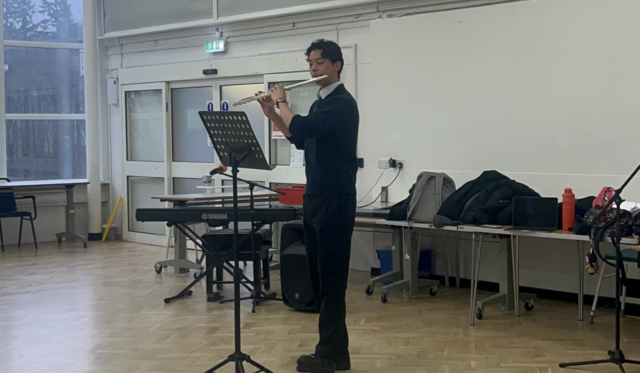
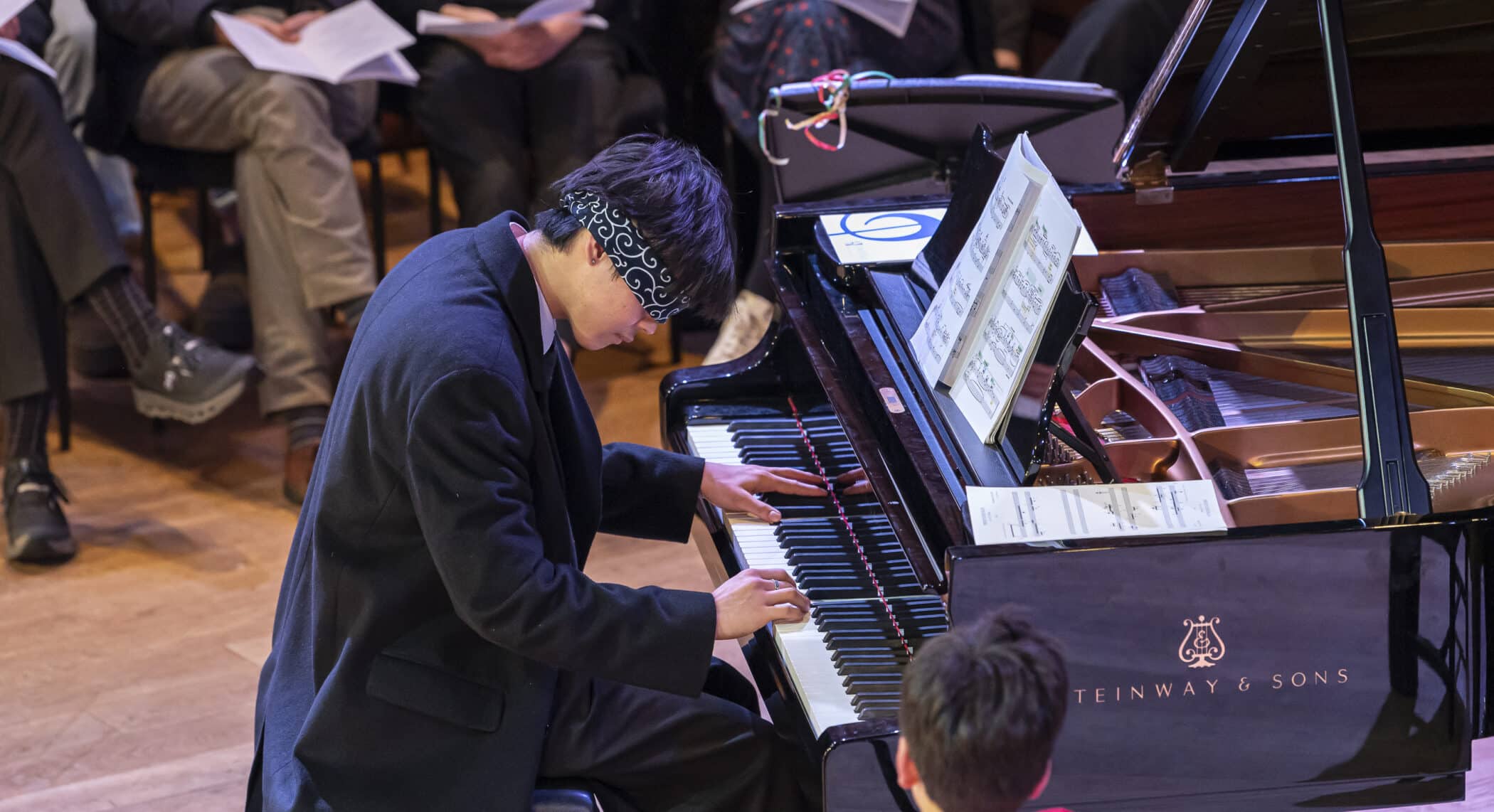
The programme showcased a variety of 20th-century and contemporary composers who revolutionized music by embracing chance. Earle Brown’s ‘Twenty-Five Pages’, performed by a Lower Sixth group comprising Noah Davis, Belinda Chan, Erica Li and Maria Gugina Milyaeva, and Morton Feldman’s ‘Intermission 6’, in a rendition by Arianna Aggarwal and Theodore Jones, gave performers the freedom to determine aspects such as page order and playing sequence, creating a fresh interpretation in every performance. Cornelius Cardew’s ‘Treatise’ with its mysterious graphic score, audaciously realised by Jaxon Pang and Ilya Reshetnick, pushed the boundaries further, allowing the musicians to find their own meaning in its abstract notation.
The Space Collective delivered a mesmerizing exploration of structured randomness with Stephen Montague’s ‘Eine Kleine Klangfarben Gigue’ and Philip Glass’s ‘Music in Similar Motion’. While these pieces adhere to set pitches, their indeterminate repetitions brought an air of unpredictability, captivating the audience. Pauline Oliveros’ ‘Rock Piece’, performed with striking originality, encouraged performers to produce sounds by striking rocks together in an improvised rhythm, embodying the very essence of chance music.
The evening’s climax came with a massed performance of John Cage’s legendary ‘Musicircus’, an immersive, multi-layered experience where different musical performances happened simultaneously throughout the hall. The result was an exhilarating soundscape that defied expectation, offering the audience a truly unique auditory adventure.
The concert not only highlighted the historical significance of aleatoric music but also invited both performers and listeners to rethink their relationship with sound, structure, and artistic control. In an age where predictability often reigns, Take a Chance! was a reminder of the beauty and power of the unknown.